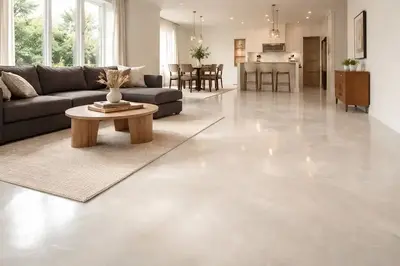
The short answer: Every epoxy floor in San Antonio is priced after a free estimate, because the price depends on the size of the space, the condition of the slab (cracks, old coatings, moisture), the coating system and finish you choose, and the prep the concrete needs. A professional price includes diamond-grind surface prep, crack repair, and a topcoat built for Texas heat.
If you're researching epoxy flooring costs in San Antonio, you've probably noticed that quotes for what sounds like the same floor can land far apart. The difference is almost always in the prep and the system underneath, not the color on top.
This guide explains what goes into the price of professional epoxy flooring in San Antonio — the same factors we look at when quoting garage floors, residential projects, and commercial spaces across Bexar County and the Hill Country.
It isn't a national average pulled from an aggregator site. It's built around the specific prep requirements that our local concrete and climate demand.
How the Coating System Affects Your San Antonio Price
Five coating systems cover almost every San Antonio project. They are listed below from the simplest build to the most heavy-duty, and the price climbs with the material, labor, and performance each one adds.
| Coating System | Best For |
|---|---|
| Solid Color Epoxy | Utility spaces, storage, budget-conscious |
| Full-Flake Epoxy + Polyaspartic | Residential garages, patios, man caves |
| Metallic Epoxy | Showrooms, living spaces, high-end garages |
Pick your size, finish, and color. Get your San Antonio price range in 60 seconds.
Open Floor Studio →Important note: A professional price includes surface preparation (diamond grinding, crack repair) and a UV-stable topcoat. The "cheap" quotes you may see from unlicensed contractors typically skip surface prep entirely and use water-based retail products. Those floors fail within months, especially in San Antonio's heat.
What Makes San Antonio Pricing Different
San Antonio isn't Houston, Dallas, or Austin when it comes to epoxy flooring costs. Several local factors directly affect what you'll pay.
1. Expansive Clay Soil = More Concrete Prep
San Antonio sits on Blackland Prairie and Edwards Plateau expansive clay. This soil swells when wet, contracts when dry, and constantly stresses your foundation. The result? More cracks, more slab movement, and more moisture vapor transmission through the concrete. Professional prep in San Antonio often requires extra crack filling with flexible polyurea sealers, moisture mitigation coatings, and post-tension slab precautions. In markets with stable soil, you skip all of this. Here, you can't.
Cost impact: moderate to significant crack repair and moisture mitigation add to the price, and the condition of your slab decides how much.
2. New Construction Concrete Needs Curing Time
San Antonio's explosive suburban growth — Kinder Ranch, Stillwater Ranch, VIDA, Mayfair, the Boerne corridor — means many garages have brand-new concrete slabs. New concrete needs a minimum of 28 days to cure before epoxy can be applied. If your home was recently built, the concrete may also have a curing compound on the surface that must be diamond-ground off before coating. This is standard prep, but some contractors skip the wait and apply too early, leading to adhesion failure.
3. Summer Heat Creates Scheduling Constraints
With 122 days above 90°F, San Antonio's summer limits when epoxy can be applied. Pot life drops dramatically in extreme heat, requiring faster crews, earlier start times, or climate-controlled application. Some contractors offset this by using quick-cure polyaspartic systems, which cost more per gallon but can be applied in a wider temperature range. Summer installations can cost more because of these constraints.
4. Hard Water and Caliche Deposits
Bexar County's hard water and caliche soil leave mineral deposits on concrete surfaces that interfere with coating adhesion. Professional cleaning and diamond grinding removes these deposits, but it adds time. DIY kits that instruct you to "just clean and acid etch" don't account for this.
Ready to Get Your San Antonio Quote?
Every project is different. Call us for a free, no-obligation estimate tailored to your specific space and goals.
Cost Factors by Project Type
Residential Garage (Most Common)
- 1-car garage (200–250 sq ft)
- 2-car garage (400–500 sq ft)
- 3-car garage (600–750 sq ft)
Square footage sets the baseline, and the slab and the system you pick do the rest. The most popular residential choice in San Antonio is a full-flake system with a polyaspartic topcoat. This system provides UV stability for the Texas sun, hot tire resistance, and the decorative finish that transforms a garage into a functional living space.
Residential Interior (Kitchen, Living Room, Flex Room)
- Metallic and decorative finishes dominate, and the design you choose drives the price
Hill Country homeowners in Boerne, Bulverde, and Fair Oaks Ranch gravitate toward metallic epoxy for living spaces — the swirling, marble-like finish complements the region's rustic-modern architectural style.
Commercial Spaces
- Restaurant/retail (500–2,000 sq ft)
- Warehouse/industrial (2,000–10,000 sq ft)
The per-square-foot cost decreases with scale.
Patio / Outdoor
- Covered patio (100–300 sq ft)
- Outdoor spaces MUST use UV-stable systems (no standard epoxy)
What's Included in a Professional Quote (and What Isn't)
A legitimate San Antonio epoxy flooring quote should include:
- Concrete inspection
- Diamond grinding surface preparation (never acid etching)
- Crack repair with flexible polyurea fillers
- Primer coat (if moisture mitigation is needed)
- Base coat (epoxy)
- Decorative layer (flake or metallic)
- UV-stable topcoat (polyaspartic or aliphatic polyurethane)
- Cleanup and final walkthrough
Red flags in a quote:
- No mention of surface preparation
- A price far below every other quote (they're using retail products or skipping prep)
- "Lifetime warranty" with no written terms document
- Stock photos on their website (they may not have local experience)
- Requiring payment in full before work starts
- No reference to slab condition assessment
- An (830) area code or out-of-market phone number
DIY vs. Professional — The Real Cost Comparison
| DIY Kit | Professional Installation | |
|---|---|---|
| Materials | Bought separately | Included in quote |
| Equipment (grinder rental) | Rented by the day | Included |
| Your time | 2–3 full days | 0 (we handle everything) |
| UV-stable topcoat | Not included | Included on every project |
| Expected lifespan in SA | 6 months – 2 years | 10 – 20+ years |
| Warranty | None | 15-year warranty (flake systems) |
| What you pay for | Kit, rental, and your time | One quote, set after a free estimate |
The trade-off is clear: a DIY kit costs less upfront but lasts a fraction as long. In San Antonio's climate, DIY kits fail because they can't handle the moisture vapor, UV exposure, and hot tire temperatures that professional systems are engineered for.
How to Get an Accurate Quote in San Antonio
Three factors determine your final price more than anything else:
- Square footage — measure your space accurately (length x width)
- Concrete condition — cracks, stains, previous coatings, moisture issues
- System choice — solid color vs. flake vs. metallic
We provide free, no-pressure quotes that include a concrete condition assessment. No paid estimates. No sales pressure. Just honest numbers based on your specific slab and the system that actually makes sense for your project.
Ready for straight answers on pricing? Call (210) 899-0609 or request your free quote online. We'll assess your concrete, recommend the right system, and give you a written quote with no surprises.
Frequently Asked Questions
How much does it cost to epoxy a 2-car garage in San Antonio?
A 2-car garage (about 450 square feet) in San Antonio is priced after a free estimate, because the price depends on the size of the space, the condition of the slab (cracks, old coatings, moisture), the system you choose, and the prep the concrete needs. A professional price includes diamond-grind prep, crack repair, and a UV-stable topcoat built for Texas heat. Call (210) 899-0609 or request a free estimate to get an exact price, with no obligation.
Why are some San Antonio epoxy quotes so much cheaper?
Quotes far below the rest almost always skip surface preparation and use water-based retail products. They omit diamond grinding, crack repair, moisture mitigation, and a UV-stable topcoat. Over San Antonio's expansive-clay slabs and intense sun, those floors peel, yellow, or delaminate within months. The low number is not a deal, it is an incomplete job.
Does San Antonio's clay soil affect epoxy flooring cost?
Yes. San Antonio sits on expansive Blackland Prairie and Edwards Plateau clay that swells and shrinks with moisture, stressing slabs and causing cracks and vapor transmission. Proper prep here often adds flexible crack filling and moisture mitigation to the price, work that stable-soil markets can skip.
Is professional epoxy worth it over a DIY kit in San Antonio?
For most San Antonio slabs, yes. A DIY kit costs less upfront but typically lasts 6 months to 2 years because it cannot handle the moisture vapor, UV exposure, and hot-tire heat our climate produces. A professional flake system lasts 10 to 20-plus years with a written warranty.
What should a legitimate San Antonio epoxy quote include?
It should spell out concrete inspection, diamond-grind prep (never acid etching alone), flexible crack repair, the base and decorative layers, and a UV-stable topcoat such as polyaspartic. Watch for red flags: no mention of prep, a price far below every other quote, lifetime warranties with no written terms, or full payment required before work begins.
Do you charge for an estimate in San Antonio?
No. We provide free, no-pressure quotes that include a concrete condition assessment and moisture check. You get a written quote based on your specific slab and the system that actually fits your space, with no paid estimates and no surprises. Call (210) 899-0609 to schedule.