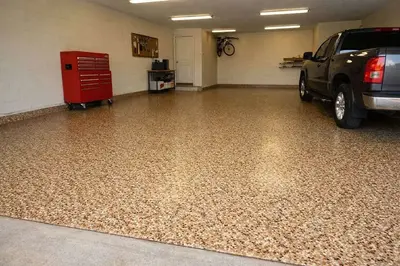
If you are researching floor coatings for your San Antonio home or business, you have likely encountered two terms: epoxy and polyaspartic. Both are professional-grade coatings that transform bare concrete into a durable, beautiful surface, but they behave very differently under San Antonio's extreme conditions.
San Antonio is not a typical market. With 122 days above 90 degrees Fahrenheit, daily humidity swings from 83% to 48%, intense UV exposure averaging 3,023 sunshine hours per year, and concrete slabs sitting on expansive clay soil that never stops moving, the wrong coating system will not just underperform. It will fail. Whether you are upgrading your garage floor or adding a decorative finish to your living space, understanding the differences between these two systems is essential for a floor that actually lasts in Texas.
This guide breaks down how each system performs under San Antonio-specific conditions, so you can make an informed decision before requesting quotes.
What Is Epoxy Floor Coating?
Epoxy is a two-part thermosetting resin: a base resin mixed with a hardener that triggers a chemical reaction, creating an extremely hard, adhesive surface bonded to your concrete slab. It has been the industry standard for decades, used in everything from residential garages to commercial warehouses.
In San Antonio, standard epoxy (also called "aromatic" epoxy) has clear strengths: excellent chemical resistance, strong adhesion to properly prepared concrete, and a thick, self-leveling application that fills minor surface imperfections. It is available in solid colors, metallic finishes, and as a base coat for decorative flake systems.
However, standard epoxy has specific vulnerabilities that matter in South Texas:
- UV sensitivity: Aromatic epoxy yellows and ambers when exposed to UV light. In San Antonio, south- and west-facing garages get hammered by direct sun. Without a UV-stable topcoat, visible yellowing can appear within 6 to 12 months.
- Slow cure time: Epoxy typically requires 24 to 72 hours to cure, depending on temperature and humidity. In San Antonio's summer heat, pot life (working time) drops from 45 minutes at 70 degrees Fahrenheit to under 20 minutes at 97 degrees Fahrenheit, making application timing critical.
- Humidity sensitivity: High humidity during application and curing increases the risk of amine blush, a waxy film that destroys adhesion between coats. San Antonio's morning humidity of 83% means early-morning applications carry significant risk.
What Is Polyaspartic Floor Coating?
Polyaspartic is a newer technology, a type of polyurea coating developed specifically to address the limitations of traditional epoxy. It was originally engineered for bridge decks and industrial infrastructure where rapid cure and UV stability were essential.
For San Antonio homeowners, polyaspartic offers several distinct advantages:
- UV stability: Polyaspartic is inherently UV-stable. It will not yellow, even in a garage door opening that faces direct Texas sun all day. This is the single most important advantage in this market.
- Rapid cure: A polyaspartic floor can be walked on in 4 to 6 hours and driven on within 24 hours, compared to 5 to 7 days for full epoxy cure. For military families at JBSA who need a fast garage upgrade before a PCS move, this matters.
- Hot tire resistance: Polyaspartic resists "hot tire pickup," the phenomenon where a hot tire (200 degrees Fahrenheit or higher after driving on San Antonio asphalt in August) bonds to the coating surface and peels it off when the car is moved. Standard epoxy is vulnerable to this; polyaspartic is not.
- Wider application window: Polyaspartic can be applied across a broader temperature and humidity range than epoxy, giving installers more flexibility in San Antonio's unpredictable climate.
The trade-off? Polyaspartic costs more per gallon, cures so fast that application requires experienced crews, and does not build thickness as efficiently as epoxy in a single coat.
Head-to-Head Comparison for San Antonio Conditions
| Factor | Epoxy | Polyaspartic | Winner for SA |
|---|---|---|---|
| UV Resistance | Poor (yellows in 6-12 months) | Excellent (no yellowing) | Polyaspartic |
| Cure Time | 5-7 days full cure | 24 hours to drive on | Polyaspartic |
| Hot Tire Pickup | Vulnerable above 180°F | Resistant above 200°F | Polyaspartic |
| Chemical Resistance | Excellent | Very Good | Epoxy (slight edge) |
| Cost (materials) | $3-8/sq ft | $6-15/sq ft | Epoxy |
| Application Window | Narrow in SA heat | Wider temp/humidity range | Polyaspartic |
| Thickness Per Coat | Higher build | Thinner per coat | Epoxy |
| Adhesion to Concrete | Excellent with proper prep | Excellent with proper prep | Tie |
| Humidity Tolerance | Sensitive (amine blush risk) | More tolerant | Polyaspartic |
The San Antonio Solution — Hybrid Systems
The best professional installations in San Antonio do not choose one or the other. They use both. A hybrid system combines the strengths of each coating where they perform best:
- Epoxy base coat: Applied first for its superior adhesion, chemical resistance, and thick build. Diamond-ground concrete bonds deeply with 100% solids epoxy.
- Decorative layer: Vinyl color flakes or metallic pigments broadcast into the wet epoxy create the visual finish, from subtle granite looks to dramatic marble swirls.
- Polyaspartic topcoat: The clear polyaspartic layer seals everything in, providing UV protection, hot tire resistance, and the high-gloss or satin finish that protects the floor for years.
This hybrid approach is what we use on most San Antonio projects. It delivers the adhesion and chemical resistance of epoxy where it matters (at the concrete interface) and the UV stability and hot tire resistance of polyaspartic where it matters (at the surface).
Want a Hybrid System for Your San Antonio Floor?
We combine epoxy base coats with polyaspartic topcoats for maximum durability in Texas heat. Get a free, no-obligation quote.
Request a Free QuoteWhy Surface Prep Matters More Than the Coating
Here is the truth that most San Antonio coating companies will not tell you: the coating system matters far less than what happens before the coating goes down.
San Antonio's expansive clay soil (Blackland Prairie and Edwards Plateau) causes constant slab movement. An estimated 20 to 30 percent of homes in this market have had or need foundation work. Post-tension slabs, standard since the 1980s, have steel cables under tension that can be damaged by improper grinding. Older homes (pre-1990) in neighborhoods like Castle Hills and the Northeast Side often lack vapor barriers, driving moisture through the slab.
Before any coating system is applied, a professional San Antonio installer must:
- Test moisture vapor transmission using ASTM F2170 or F1869 methods
- Check for post-tension slab markings (stamped "DO NOT CUT" on the garage floor)
- Diamond grind the surface to create a mechanical bond profile (CSP 2-3) — never acid etch
- Fill cracks with flexible polyurea sealers that move with the slab instead of cracking
- Inspect for previous foundation repairs (mudjacked, foam-lifted, or pier-supported areas)
A $15 per square foot polyaspartic system will fail just as fast as a $4 per square foot epoxy if it is applied over a slab that was not properly assessed and prepared. This is why we test every slab before we touch it.
What About DIY Epoxy Kits?
Big-box store epoxy kits ($50 to $150) are water-based formulas with less than 50% solids content. Professional systems use 100% solids epoxy and commercial polyaspartic, materials not available at retail. In San Antonio's climate, DIY kits face three fatal problems:
- No moisture testing: If your slab has moisture vapor issues (common in San Antonio), the kit peels within weeks.
- No UV protection: No DIY kit includes a UV-stable topcoat. The floor yellows by summer.
- No surface prep: The kit instructions say "acid etch." In San Antonio, acid etching fails to open concrete pores sufficiently, so the coating sits on the surface and delaminates.
We regularly repair floors where a homeowner spent $150 on a kit, watched it fail, and then spent $3,000 or more on a professional redo. The "savings" became a sunk cost.
Which System Is Right for Your San Antonio Project?
Choose a full polyaspartic system if:
- Your garage faces south or west (maximum UV exposure)
- You need a fast turnaround (military PCS, home sale, etc.)
- You park hot vehicles (trucks, SUVs that sit in San Antonio sun all day)
- Budget allows $8 to $15 per square foot
Choose a hybrid epoxy + polyaspartic system if:
- You want the best balance of performance and cost ($5 to $12 per square foot)
- You are coating a large residential or commercial space
- You want decorative flake or metallic finishes
- You are looking for maximum chemical resistance (workshops, commercial kitchens)
Choose full epoxy with UV topcoat if:
- The space has minimal UV exposure (interior rooms, enclosed commercial areas)
- Budget is primary concern ($3 to $8 per square foot)
- Chemical resistance is the top priority (industrial facilities, auto shops)
Frequently Asked Questions
Is polyaspartic better than epoxy in San Antonio?
For sun-exposed and outdoor-adjacent spaces in San Antonio, polyaspartic usually performs better because it does not yellow under UV, cures fast, and flexes through temperature swings. For interior spaces with little UV, a quality epoxy base with a UV-stable topcoat is often the better value. Many of the best San Antonio floors are hybrids: an epoxy base coat with a polyaspartic topcoat.
Why does standard epoxy turn yellow in San Antonio?
Standard aromatic epoxy is chemically sensitive to UV light. In San Antonio, which averages around 3,000 sunshine hours a year, south- and west-facing garages take direct sun and can show visible yellowing within 6 to 12 months if there is no UV-stable topcoat. A polyaspartic or aliphatic topcoat prevents that ambering.
Does polyaspartic cost more than epoxy?
Yes. Polyaspartic systems typically cost 20 to 40 percent more than an equivalent epoxy system because the material is more expensive and installation conditions are more demanding. The trade-off is faster cure, often a one-day turnaround, plus UV stability and better flexibility over San Antonio's moving clay slabs.
Which coating handles San Antonio's clay soil movement better?
Polyaspartic is more flexible than rigid epoxy, so it tolerates the small slab movements caused by San Antonio's expansive clay slightly better. But coating chemistry matters less than prep: flexible crack repair, joint treatment, and diamond grinding are what actually keep either system from cracking as the slab moves.
Can polyaspartic be installed in one day in San Antonio?
Often yes. Polyaspartic cures fast enough that a standard garage can be ground, coated, and back in light service within a day, with full cure in about 24 hours. Timing still depends on slab condition and weather, since extreme summer heat shortens working time, so a same-day install is confirmed after the slab assessment.
Why does surface prep matter more than the coating itself?
Both epoxy and polyaspartic bond to the concrete, not to dirt, moisture, or a curing compound. In San Antonio, where humidity and clay-driven vapor transmission are high, a flawless coating over an unprepped slab will still peel. Diamond grinding, calcium chloride moisture testing, and flexible crack repair are what determine whether the floor lasts, regardless of which chemistry sits on top.
Get a Free Assessment for Your San Antonio Floor
Every San Antonio floor has a story: clay soil movement, moisture history, sun exposure, and previous coatings all factor into the right system recommendation. We start every project with a free concrete assessment that includes moisture testing, crack mapping, and an honest recommendation for the system that actually makes sense for your slab and your budget.
Call us at (210) 899-0609 or request a free quote to get started.