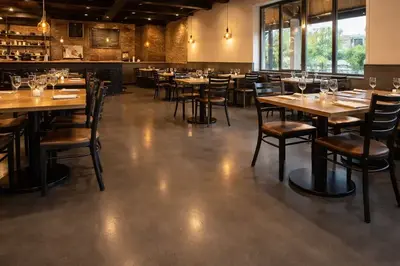
Commercial epoxy flooring gives San Antonio businesses a durable, seamless, sanitary, slip-resistant floor that handles forklifts, foot traffic, chemicals, and health-code requirements — when it is specced and prepped for our slabs and our heat. That is the short answer. The longer answer, below, walks through why business owners pick epoxy, which system fits which industry, what it costs, and how a good installer keeps your doors open while the floor goes down.
Whether you run a distribution warehouse off the I-35 corridor, a restaurant near the Pearl, an auto shop in Converse, or a medical suite in Stone Oak, the floor under your operation is doing more work than almost any other surface in the building. A coating that is matched to your traffic and your slab pays for itself in years of low-maintenance service. A coating that is not will peel, chip, and embarrass you in front of customers and inspectors.
Why Businesses Choose Epoxy
Commercial decision-makers care about uptime, liability, and lifecycle cost, not the prettiest swatch. Epoxy and its cousin polyaspartic win on all three for a simple reason: they turn a porous, dusting concrete slab into a single bonded surface engineered for abuse. Here is what that buys a San Antonio business.
- Durability under heavy traffic. A properly installed system absorbs forklift wheels, pallet jacks, dropped tools, and constant foot traffic without gouging or wearing through the way bare concrete or tile does.
- Seamless surface. There are no grout lines, no tile joints, and no seams for bacteria, grease, or moisture to hide in. That matters everywhere, and it is non-negotiable in food and medical settings.
- Sanitary and easy to sanitize. A non-porous floor wipes, mops, and chemically cleans down to a true clean surface, which is exactly what a Bexar County health inspector wants to see in a kitchen or prep area.
- Slip-resistance options. Aggregate additives build a defined texture into the floor, so wet zones get the grip they need without sacrificing cleanability.
- Chemical resistance. The right topcoat shrugs off oils, solvents, mild acids, and cleaning chemicals that would etch or stain raw concrete.
- Fast clean-up and a professional look. Spills wipe up instead of soaking in, and a crisp, uniform floor signals to customers and staff that the operation is run well.
- Long service life lowers lifecycle cost. A floor that lasts 10 to 20-plus years and rarely needs attention costs far less per year than one you patch, re-tile, or recoat constantly.
Epoxy by Industry
The best system depends on what happens on top of the floor all day. These are the commercial categories we see most across San Antonio and the surrounding Hill Country towns.
Warehouses & Distribution
San Antonio's logistics business runs along the I-35 and I-10 corridors, and warehouse floors take a beating from forklift traffic, pallet jacks, and abrasion. The priority here is wear resistance and clear line striping for aisles, racking lanes, and safety zones. A high-build solid-color epoxy handles the load, and color-coded striping keeps a busy distribution floor organized and OSHA-friendly.
Restaurants & Commercial Kitchens
Bexar County health codes expect slip-resistant, sanitary floors in food-prep areas, and a back-of-house kitchen sees grease, hot water, steam, and thermal shock near fryers and dish pits. A textured, slip-resistant epoxy system builds in the grip inspectors look for. Restaurants around the Pearl and downtown districts lean on these systems because they hold up to the punishment and still clean down fast at close.
Retail & Showrooms
Retail floors have to look the part and still survive carts, foot traffic, and the occasional dropped product. Here appearance shares top billing with durability, so metallic and decorative flake systems do well. They deliver a high-end, polished look for showrooms and storefronts in Alamo Heights, Stone Oak, and New Braunfels while still wearing like a commercial floor should.
Auto Shops & Dealerships
Service bays and showroom floors at auto shops in Schertz, Live Oak, and Universal City face hot tires, dropped tools, oil, brake fluid, and the point loads of lifts and jacks. The system has to resist hot-tire pickup and chemical staining, which is where a flake epoxy with a chemical-resistant topcoat earns its keep. A clean, bright bay floor also reads as professional to customers waiting on a vehicle.
Medical & Labs
Clinics, dental offices, and labs need sanitary, seamless floors with integral cove base so there is no crevice at the wall for contaminants to collect. These spaces in Boerne, Fair Oaks Ranch, and around the South Texas Medical Center prioritize cleanability and infection control above all, and a seamless epoxy floor with coved edges is built for exactly that.
Commercial System Types
Two system families cover most commercial jobs in San Antonio. The right one balances how hard the floor gets used against budget and appearance.
| System | Best Use | Key Strength | Relative Cost |
|---|---|---|---|
| Solid-color epoxy | Warehouses, storage, back-of-house utility | Durable, economical, easy to stripe | Lowest |
| Full-flake epoxy + polyaspartic | Retail, showrooms, auto bays, light commercial | Appearance plus durability and hot-tire resistance | Moderate |
Rule of thumb: the more the floor is on display to customers, the more a decorative flake or metallic finish earns its premium.
Planning a Commercial Floor in San Antonio?
Tell us your industry, square footage, and slab condition and we will recommend the right system — with a written quote and a downtime plan, before any deposit.
The San Antonio Factor
A commercial floor is only as good as the slab it bonds to, and San Antonio slabs come with local complications that an out-of-town crew often overlooks. At commercial square footage, getting these wrong is expensive, so system selection and prep matter even more than they do on a residential garage.
Expansive Clay and Slab Movement
San Antonio sits on Blackland Prairie and Edwards Plateau expansive clay that swells when wet and shrinks when dry. Under a big commercial slab, that movement shows up as cracks and active joints. A durable commercial floor has to treat cracks with flexible fillers and honor the slab's control joints rather than coating straight over them, so the floor can move without telegraphing a crack through the finish.
Texas Heat and Pot Life on Large Pours
On a 5,000 or 10,000 square foot pour, the material's pot life is the enemy in summer. San Antonio heat shortens working time dramatically, so large commercial installs need experienced crews, early start times, and sometimes fast-cure polyaspartic chemistry that tolerates a wider temperature window. Rushing a big pour in the heat is how you end up with roller marks, lap lines, and weak spots.
Moisture Testing on Slab-on-Grade
Most commercial buildings here sit on slab-on-grade, and our clay drives moisture vapor up through the concrete. Skipping moisture testing is the fastest way to delaminate an expensive commercial floor months after install. A proper job tests the slab and, where readings are high, installs a moisture-mitigation primer before the build coats go down.
UV at Dock Doors and Entries
Standard epoxy ambers in sunlight. At warehouse dock doors, storefront entries, and any zone that catches direct Texas sun, the topcoat needs to be UV-stable polyaspartic or aliphatic polyurethane so the floor does not yellow at the threshold while the interior stays true. It is a small detail that separates a floor that looks new for years from one that shows a sun line in season one.
Cost and What Drives It
Commercial pricing is driven by scale and condition, and the per-square-foot cost drops as the area grows, so a 500 to 2,000 square foot restaurant or retail space and a 2,000 to 10,000 square foot warehouse or industrial floor are priced very differently. Every project is priced after an on-site look, and where you land comes down to a handful of drivers.
- Square footage. Bigger floors cost more in total but less per foot, because mobilization and prep setup spread across more area.
- Slab condition and prep. Heavy cracking, old coatings, oil-soaked concrete, or failed moisture tests all add diamond grinding, crack repair, and mitigation before the first coat.
- System choice. A plain solid-color warehouse floor and a decorative showroom finish are different worlds of material cost.
- Downtime and after-hours scheduling. Nights, weekends, and phased sequencing to keep you open add labor cost, but they protect your revenue while the floor cures.
- Cove base. Integral coved edges for sanitary spaces add material and labor but are essential in medical and food settings.
- Line striping. Aisle markings, safety zones, and traffic lanes add a layer of layout and masking work in warehouses and shops.
For a deeper breakdown of how these factors move the number, see our full San Antonio epoxy flooring cost guide. The takeaway for a business owner: a legitimate commercial quote spells out prep, the system, cove base, and striping line by line, so you can see exactly what you are paying for.
Minimizing Downtime
The number one objection we hear from San Antonio business owners is not cost, it is "I can't close." A good commercial installer plans the job around your operating schedule, not the other way around. Here is how downtime gets controlled.
- Fast-cure polyaspartic for one-day and overnight zones. In areas that have to reopen quickly, polyaspartic topcoats cure fast enough to support foot traffic the next morning and full traffic within a day or two.
- Phased and sectioned installs. Large warehouses and shops get sequenced section by section, so one part of the floor stays in service while another cures behind barriers.
- After-hours and weekend scheduling. For restaurants, retail, and offices, we work nights and weekends so the install happens when you are closed and the floor is ready by the time you reopen.
- Realistic return-to-service timelines. We give you honest cure windows up front — light foot traffic, full foot traffic, and heavy equipment or forklift traffic each have their own timeline — so you can plan around them instead of being surprised.
A typical commercial install runs three to five working days for prep, base, decorative layer, and topcoat, plus cure time. With phasing and after-hours work, most San Antonio businesses never fully close. We map the sequence with you before anyone shows up, so you know which zones are offline and when, from day one.
Frequently Asked Questions
How much does commercial epoxy flooring cost in San Antonio?
Every San Antonio commercial project is priced after a free on-site estimate, and the per-foot price drops as the area grows. The system, slab condition, cove base, line striping, and after-hours scheduling are what move the number. Call (210) 899-0609 or request a free estimate to get an exact price, with no obligation.
Which epoxy system is best for a San Antonio commercial kitchen?
For a commercial kitchen in Bexar County, a textured, slip-resistant system is usually the right call, because it helps meet health-code expectations. A smooth solid-color epoxy is generally too slick for a wet kitchen.
How long does commercial epoxy take to install?
A typical San Antonio commercial install runs three to five working days for prep, base, decorative layer, and topcoat, plus cure time before the space carries full traffic. Fast-cure polyaspartic topcoats can compress small zones into a one-day or overnight turnaround. Large warehouses are usually phased by section so part of the floor stays in service while another section cures.
Can you install without shutting down my business?
In most cases, yes. We phase larger floors section by section, schedule after-hours and weekend work, and use fast-cure polyaspartic in zones that have to reopen quickly. The goal is to keep your San Antonio business operating while the floor goes down, and we map the sequence with you before any work starts so you know exactly which areas are offline and when.
Is epoxy slip-resistant enough for health codes?
Yes, when the right texture is specified. An aggregate additive builds a defined slip-resistant profile into the floor, which is what wet commercial kitchens, restrooms, and food-prep areas in Bexar County need. We select the texture for each zone so a back-of-house kitchen gets more grip than a dry retail showroom that prioritizes appearance.
How long does a commercial epoxy floor last?
A professionally installed commercial epoxy floor in San Antonio commonly lasts 10 to 20-plus years when the slab is properly prepped and the system is matched to the traffic. The biggest factor is preparation: a diamond-ground slab is what keeps the floor bonded through years of forklift and foot traffic.
Related Articles
Comparing Epoxy Flooring Types in San Antonio
Solid color, flake, and metallic — which system fits your space and budget.
How Much Does Epoxy Flooring Cost in San Antonio?
Honest 2026 pricing by system type, square footage, and the local prep factors that drive cost.
How Long Does an Epoxy Floor Last in San Antonio?
Realistic lifespan by system, plus the prep and maintenance that keep a floor bonded for years.